
The Delhi High Court has refused to grant bail to activists Umar Khalid and Sharjeel Imam in a case filed under the Unlawful Activities (Prevention) Act (UAPA) concerning the "larger conspiracy" behind the February 2020 north-east Delhi riots. The court cited a Supreme Court order and the ongoing investigation into their alleged roles as masterminds.
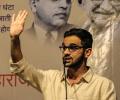
The Jawaharlal Nehru University Students' Union (JNUSU) proceeded with a discussion on former student Umar Khalid's book, "Fractured Communities: Adivasi Histories and the Politics of Power," despite the university cancelling the original venue booking. The event, planned to observe Indigenous Peoples' Day, was held outside an academic building after the JNUSU condemned the university's "arbitrary" decision.

The Central Board of Film Certification (CBFC) flagged the proposed screening of an uncertified documentary on jailed activist Umar Khalid at IIIT-Hyderabad, citing violations of the Cinematograph Act. IIIT-Hyderabad subsequently distanced itself from the event, stating no recognised student bodies had organised it. The screening, titled "Prisoner No. 626710 is Present," was reportedly cancelled by students, following a similar postponement at NLSIU Bengaluru due to opposition.
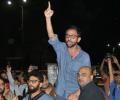
Bengaluru Police have registered an FIR against an unidentified woman for allegedly displaying placards supporting jailed activists Umar Khalid and Sharjeel Imam during a student protest at Freedom Park. The incident occurred on Friday, with police alleging the placards were provocative and intended to incite unrest. The complaint was filed after CCTV footage review, and a case has been registered under Section 192 of the Bharatiya Nyaya Sanhita, 2023.

Jawaharlal Nehru University (JNU) cancelled permission for a discussion on a book authored by its former student Umar Khalid, currently jailed in the 2020 northeast Delhi riots conspiracy case, citing 'non-disclosure of full facts' about the event. The JNUSU condemned the decision as 'arbitrary and authoritarian', vowing to proceed with the discussion at an alternative venue.
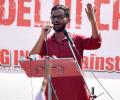
A Delhi court has dismissed the bail plea of activist Umar Khalid, who is accused in the 2020 northeast Delhi riots case. The court rejected his application for interim bail to attend his uncle's post-death ritual and care for his mother.

A Delhi court has reinstated jailed activist Umar Khalid's right to two weekly video meetings (e-mulakats) with his family, overturning a reduction to one meeting. The court noted Khalid had consistently used two e-mulakats for six years without violating prison rules, despite jail authorities arguing for a single weekly meeting under current regulations. Khalid is on trial in a 2020 northeast Delhi riots conspiracy case.
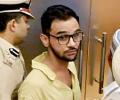
A Delhi court has dismissed the bail applications of activists Umar Khalid and Sharjeel Imam in the 2020 Delhi riots conspiracy case, citing its obligation to follow a previous Supreme Court order that rejected their bail.
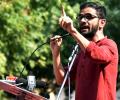
The BJP has accused the Congress-led Karnataka government of supporting Umar Khalid by allowing an event linked to him in Bengaluru, despite objections. The BJP highlighted Khalid's legal status, noting he has not been granted relief by courts in cases related to the Delhi riots and faces charges under the UAPA.
The Delhi High Court has granted three-day interim bail to activist Umar Khalid, who is in custody under UAPA, to visit his mother who is undergoing surgery.
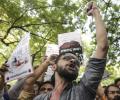
The Supreme Court has denied bail to Umar Khalid in the 2020 Delhi riots conspiracy case, citing a prima facie case against him under the UAPA. Other activists were granted bail. Khalid's father expressed disappointment, while a friend shared Khalid's reaction.

Former Tehelka editor Tarun Tejpal has been convicted by the Bombay High Court's Goa bench in a 2013 rape case and sentenced to 10 years' rigorous imprisonment, overturning his 2021 acquittal. Tejpal claims he is a "political victim" and will challenge the verdict in the Supreme Court, alleging his journalistic career has been targeted.
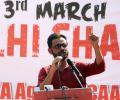
The Supreme Court has dismissed activist Umar Khalid's plea seeking a review of a verdict denying him bail in connection with the 2020 Delhi riots conspiracy case.

Senior Congress leader Prithviraj Chavan defends New York City Mayor Zohran Mamdani's note for jailed activist Umar Khalid, emphasizing the importance of human rights.
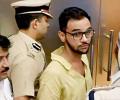
Khalid is currently in judicial custody in connection with a larger conspiracy case related to the 2020 North East Delhi violence.
Student activist Umar Khalid has petitioned the Supreme Court for a review of the verdict denying him bail in connection with the 2020 Delhi riots conspiracy case, arguing that there were errors in the initial decision.
The Supreme Court has refused to grant bail to activists Umar Khalid and Sharjeel Imam in the 2020 Delhi riots conspiracy matter, citing a prima facie case against them under the UAPA. However, bail was granted to other activists in the same case.
The Supreme Court granted interim bail to two Delhi riots accused, while addressing concerns about conflicting views on bail under the Unlawful Activities Prevention Act (UAPA). The court referred the question of law on whether prolonged incarceration can override UAPA restrictions to a larger bench.
Activist Umar Khalid seeks bail in the UAPA case related to the 2020 Delhi riots, claiming lack of evidence and denying conspiracy charges. Other activists also argue for bail, citing delays and insufficient evidence.

US lawmakers have written to the Indian Ambassador to the US, expressing concern over the prolonged detention of activist Umar Khalid and urging a fair trial in accordance with international law.

India has expressed its disapproval of New York Mayor Zohran Mamdani writing a note to jailed activist Umar Khalid, emphasizing the importance of respecting the independence of the judiciary in other democracies.
A group of US lawmakers has written to the Indian Ambassador to the United States, urging a fair and timely trial for activist Umar Khalid, who has been detained under the UAPA.
The prosecution had opposed the bail pleas saying it was not a case of spontaneous riots but a case where riots were "planned well in advance" with a "sinister motive" and "well-thought-out conspiracy".
The Delhi police vehemently opposed the bail pleas of activists Umar Khalid, Sharjeel Imam and others in the February 2020 riots case, saying it had become a trend now for doctors and engineers to engage in anti-national activities. The police cited inflammatory speeches and violent protests as reasons for opposing bail.
Activist Umar Khalid has appealed to the Supreme Court against the Delhi High Court's decision to deny him bail in a case under the Unlawful Activities (Prevention) Act (UAPA) related to the alleged conspiracy behind the February 2020 Delhi riots.
The Supreme Court has reaffirmed that bail is the general rule, even in cases registered under the Unlawful Activities (Prevention) Act (UAPA), while granting bail to an accused in a narco-terror case.
The Supreme Court on Friday adjourned to September 22 the hearing on bail pleas of activists Umar Khalid, Sharjeel Imam, Gulfisha Fatima and Meeran Haider in the Unlawful Activities (Prevention) Act (UAPA) case related to the alleged conspiracy behind the February 2020 riots in Delhi.

A violent clash broke out between two groups of students at Jawaharlal Nehru University (JNU) campus on Friday during a 'Visarjan Shobha Yatra' organised on the occasion of Vijayadashami, following the nine-day Navratri celebrations.
Arrested in September 2019 by the Delhi police for making 'provocative statements' when Donald J Trump was on his visit to India, Dr Umar Khalid has now spent three years in jail without being convicted of an offence, points out Aakar Patel.
Former Jawaharlal Nehru University student and activist Umar Khalid has completed four years in jail after being arrested in connection with the 2020 northeast Delhi communal riots.
The Supreme Court on Monday sought the Delhi police's response on the bail pleas of activists Umar Khalid, Sharjeel Imam, Gulfisha Fatima and Meeran Haider in the UAPA case related to the alleged conspiracy behind the February 2020 riots in Delhi.
The Supreme Court on Tuesday adjourned for a week the hearing on a plea filed by former Jawaharlal Nehru University student Umar Khalid seeking bail in a case lodged under anti-terror law Unlawful Activities (Prevention) Act (UAPA) over his alleged involvement in the conspiracy behind the northeast Delhi riots of February 2020.

'Because, if someone remains an undertrial prisoner for five or seven years and is finally proven innocent, how will you compensate for the time lost?'

Khalid has been booked under the stringent Unlawful Activities (Prevention) Act (UAPA).
Special Public Prosecutor Amit Prasad said Khalid's mobile phone data revealed he was in contact with some actors, politicians, activists and celebrities and sent them some links by certain news portals against the Delhi Police.
The Supreme Court on Wednesday adjourned till January 10 the hearing on the bail plea of former Jawaharlal Nehru University (JNU) student Umar Khalid in a case lodged under anti-terror law Unlawful Activities (Prevention) Act (UAPA) over his alleged involvement in the conspiracy behind the northeast Delhi riots of February 2020.
Additional Sessions Judge Amitabh Rawat, who was scheduled to pronounce the order on Monday, posted the matter for Wednesday, saying it was not ready.
Arguing his bail plea in the riots conspiracy case before additional sessions Judge Amitabh Rawat, his lawyer referred to the supplementary charge sheet filed in the case and said that the police wished to paint every accused with the same brush while adding tadka (flavour) to it.

Additional Sessions Judge Pulastya Pramachala passed the order while directing that charges be framed against Aam Aadmi Party (AAP) leader Tahir Hussain and 10 others in the case related to alleged rioting, vandalism and arson at a parking lot in February 2020.
Khalid was booked under the Unlawful Activities (Prevention) Act (UAPA) and provisions of the Indian Penal Code for allegedly being a mastermind of the February 2020 riots, which had left 53 people dead and more than 700 injured.
